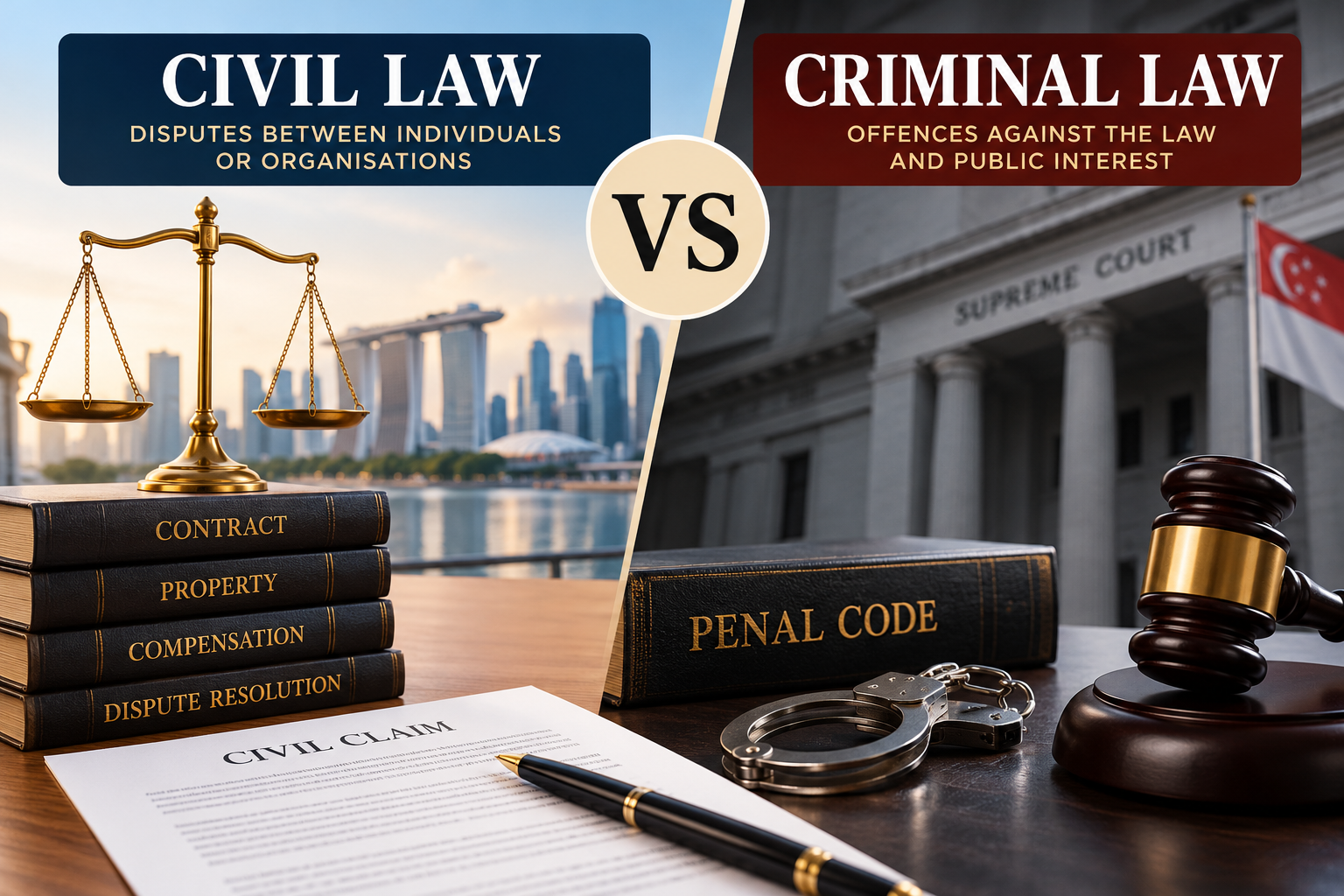
Understanding civil law vs criminal law in Singapore is important because both areas of law serve different purposes. Civil law generally deals with disputes between individuals, businesses, or organisations, while criminal law addresses offences against the law that may result in punishment.
Although both involve legal proceedings, they differ in their objectives, procedures, burden of proof, and possible outcomes. Knowing these differences can help individuals understand their legal rights and determine the appropriate course of action.
What Is Civil Law in Singapore?
Civil law deals with legal disputes between parties, often involving private rights, contractual obligations, property, or financial matters.
In Singapore, civil proceedings generally begin when one party brings a claim against another. The person or organisation initiating the claim is known as the claimant, while the party responding is called the defendant.
Common examples of civil disputes include:
- Contract disputes: Disagreements involving contractual obligations or breaches of contract.
- Property disputes: Conflicts involving property ownership, tenancy agreements, or property transactions.
- Debt recovery: Legal action to recover outstanding payments.
- Personal injury claims: Claims for compensation arising from accidents or negligence.
- Employment disputes: Disagreements involving employment rights or contractual obligations.
- Family disputes: Matters involving divorce, maintenance, and other family-related issues.
The main purpose of civil proceedings is usually to resolve disputes and provide an appropriate legal remedy rather than punish wrongdoing.
What Is Criminal Law in Singapore?
Criminal law deals with conduct that Singapore legislation recognises as a criminal offence.
Criminal proceedings are generally brought by the Public Prosecutor against an accused person. The prosecution must establish that the accused committed the alleged offence according to the required legal standard.
Criminal offences in Singapore are governed by legislation such as the Penal Code 1871, the Misuse of Drugs Act 1973, and other statutes.
Common criminal offences include:
- Theft and robbery
- Assault and voluntarily causing hurt
- Cheating and fraud
- Criminal breach of trust
- Drug-related offences
- Sexual offences
- Harassment-related offences
- Certain traffic offences
Depending on the offence and circumstances, a convicted person may face imprisonment, a fine, caning where legally permitted, or other penalties prescribed by law.
Unlike civil proceedings, criminal cases focus primarily on determining criminal responsibility and imposing appropriate punishment.
Civil Law vs Criminal Law: Main Differences
Although civil and criminal cases may both involve court proceedings, they operate differently.
1. Purpose of Legal Proceedings
Civil law aims to resolve disputes and provide remedies to parties whose legal rights have been affected.
Criminal law seeks to address conduct prohibited by legislation, protect public interests, and impose punishment where criminal responsibility is established.
2. Parties Involved
In civil proceedings, the parties are generally the claimant and defendant.
In criminal proceedings, the case is usually brought by the Public Prosecutor against the accused person.
3. Burden of Proof
One of the most important differences is the standard of proof.
In civil cases, the claimant generally must establish the claim on the balance of probabilities. This means showing that the claim is more likely than not to be true.
In criminal cases, the prosecution must prove the accused person’s guilt beyond a reasonable doubt, which is a higher standard.
4. Possible Outcomes
Civil cases may result in remedies such as monetary compensation, injunctions, declarations, or orders requiring a party to perform certain obligations.
Criminal cases may result in an acquittal or conviction. Following a conviction, the court may impose a sentence permitted by the applicable law.
5. Legal Procedures
Civil proceedings are generally governed by the Rules of Court 2021 or other applicable procedural rules.
Criminal proceedings are primarily governed by the Criminal Procedure Code 2010 and relevant legislation.
Both processes require compliance with court procedures and deadlines.
Comparison of Civil and Criminal Law
| Aspect | Civil Law | Criminal Law |
| Main purpose | Resolve legal disputes | Address and punish offences |
| Parties | Claimant and defendant | Prosecution and accused |
| Standard of proof | Balance of probabilities | Beyond reasonable doubt |
| Typical matters | Contracts, property, debts | Theft, assault, fraud |
| Possible outcomes | Damages, injunctions, declarations | Acquittal or criminal sentence |
| Main legislation | Civil statutes and procedural rules | Penal Code, CPC and other criminal statutes |
Can One Incident Lead to Both Civil and Criminal Cases?
Yes. In Singapore, the same incident may give rise to both civil and criminal proceedings.
For example, if a person physically assaults another individual, the incident may result in criminal charges for voluntarily causing hurt.
At the same time, the injured person may bring a civil claim seeking compensation for medical expenses, lost income, and other legally recoverable losses.
Similarly, allegations of fraud may lead to criminal investigations while also giving rise to civil claims involving financial losses.
These proceedings serve different purposes and are generally assessed independently.
A criminal conviction does not automatically determine every issue in a related civil claim, and the outcome of a civil case does not necessarily determine criminal liability.
How Are Civil Disputes Resolved in Singapore?
Civil disputes do not always require a full court trial.
Depending on the circumstances, parties may resolve their disagreements through:
- Negotiation: Parties communicate directly or through their lawyers to reach an agreement.
- Mediation: A neutral mediator assists the parties in exploring a mutually acceptable resolution.
- Arbitration: An appointed arbitrator determines the dispute, generally through a binding decision.
- Litigation: The dispute is brought before the appropriate court for determination.
The most suitable approach depends on the nature of the dispute, the parties’ objectives, the amount involved, and any applicable contractual provisions.
What Happens During Criminal Proceedings?
Criminal proceedings in Singapore may involve several stages, depending on the nature of the alleged offence.
These may include police investigations, arrest, formal charges, court mentions, bail applications, pre-trial proceedings, and trial.
An accused person may plead guilty or claim trial.
If the accused pleads guilty and the court accepts the plea, the court may proceed to conviction and sentencing.
If the accused claims trial, the prosecution must prove the charge beyond a reasonable doubt. The defence may challenge the evidence and present its case in accordance with applicable procedures.
The court will then determine whether the accused should be convicted or acquitted.
Why Understanding Civil Law vs Criminal Law Matters
Understanding the difference between these two areas of law can help individuals make better decisions when facing legal difficulties.
For example, a business owner dealing with unpaid invoices may need to consider civil debt recovery proceedings rather than filing a criminal complaint.
On the other hand, someone accused of theft or assault may require criminal defence representation.
Identifying the nature of a legal matter early can help parties understand their rights, responsibilities, potential risks, and available legal options.
It may also prevent unnecessary delays or the use of inappropriate legal procedures.
When Should You Consult a Lawyer?
Legal disputes and criminal allegations can have significant financial, professional, and personal consequences.
Seeking legal advice may be particularly important when:
- You have received a court document or legal demand.
- You are involved in a contractual or property dispute.
- You are being investigated for a criminal offence.
- You have been arrested or formally charged.
- You are considering bringing a claim against another party.
- You are uncertain about your legal rights or obligations.
A lawyer can assess the circumstances, explain the applicable legal framework, and advise on the available options.
Conclusion
Understanding civil law vs criminal law helps individuals recognise how different legal issues are handled in Singapore.
Civil law primarily concerns disputes involving private rights and obligations, while criminal law addresses offences that may attract punishment under Singapore legislation.
Although the two systems have different purposes and procedures, both play important roles in maintaining fairness, accountability, and the rule of law.
Whether you are dealing with a civil dispute or facing criminal allegations, obtaining legal advice can help you understand the legal process and make informed decisions.
Need Legal Assistance in Singapore?
At Adel Law LLC, our lawyers assist clients with civil disputes and criminal law matters. Whether you require advice on a legal claim or representation in criminal proceedings, our team can help you understand your options and navigate the legal process.
Contact Adel Law LLC to arrange a legal consultation.